Articles written by me that have been published in print or on sites with stringent approvals. And recognition of my articles/blogs that aren't paid for or otherwise personally influenced.
Sunday, 16 November 2014
The Foodie & the Fotographer : Champaner & The Glory that Surrounds It.
16 November 2014
EAT AND DRIVE :- History, Spirituality, Royalty, Natural Beauty & a Unique Craft @ Champaner, Pavgadh, Jambughoda & Sankheda
The Foodie & The Fotographer – Kim & Brajesh go Road Tripping through Gujarat.
A Month Ago, (DNA, 16 Oct 14) we explored Patan, a recently declared UNESCO World Heritage Site, but Champaner was given the same honour more than 10 years ago in 2004, as the only complete and unchanged Islamic pre-Mughal city.
In 1484, Sultan Mahmud Begarah took possession of the Pavgadh Hill fort and renamed it Muhammadabad. Champaner was constructed as the Capital City of Gujarat by the 16th Century.
Today the town sees hordes of visitors, but 99.9% of them head only to Pavgadh Hill to the temple of Kalika Mata – belived to be a Shaktipeeth because Sati’s toe is supposed to have fallen here. Unusually, there is a shrine built over the temple dedicated to Muslim Saint Sadanshah, who supposedly pacified Mahakali, who in a fit of rage had set out to destroy the world.
It is possible to take your vehicle half way up the hill to the parking area, which has a basic Government rest house with very nice staff, who have snacks and tea on offer (if they are open) and usable washrooms. The view from their basic outdoor dining is gorgeous and with a steaming cup of tea and piping hot pakodas, you can forget the world and the crowds outside.
Many pilgrims climb the Pavgadh hill in pilgrimage (4-5 hours round trip), but for those less physically inclined, there is a mono-cable ropeway that can carry 1200 people per hour. However, this ropeway only operates in certain seasons and is often closed for repairs and maintenance, so be prepared for that eventuality.
The Champaner Heritage Site encompasses this temple, the living town of Champaner and the Heritage Buildings spread all over the area, many of which still lie unexcavated. You can see some of these monuments as you drive up the hill. If something looks interesting, park your vehicle (at a proper space that doesn’t obstruct other traffic) and get out for a walk. Walking around these monuments is the only way to truly appreciate their size and intricate work.
The ASI Website lists over 35 monuments that have been studied, but not all of them are easily accessible. Our car often had its capabilities tested to the maximum on some of the side roads and we still couldn’t find some of the monuments on the list. We treated the whole exercise as a treasure hunt and had loads of fun.
The main series of monuments is located directly opposite the path that leads up to Pavgadh Hill. The Jami Masjid here is accepted to be the model for later mosque architecture in India. Some of these Historic sites, now house Government offices. If you ask nicely, they will let you take a walk around their premises.
Champaner is 154 km away from Ahmedabad and takes around 2.5 hours to drive, bypassing Baroda, via Halol. However, you can also spend Friday night in Baroda and then it is less than an hours drive (58 km) to Champaner. You can choose to return to Ahmedabad via Baroda (stopping here for lunch), We however prefer the more scenic route via Jambughoda (25 km) & Sankheda (40km). Then another 167 km to Ahmedabad, for a round trip of around 400 km.
The Nature Lovers Retreat is a Heritage Property of the Jamughoda Royal family, that has guesthouse style rooms and serves brilliant food. Call at least 24 hours ahead to book for lunch. You may not see any Wildlife, but the Greenery is a soothing balm to the soul. Next time we may try the recently opened Champaner Heritage Resort or the Mount Heritage Resort. If you want to explore further, head to the Jhund Hanuman temple in the sanctuary, with its 18foot high murti, believed to date to the Mahabharata era or the Government Guest House which has great views of the reservoirs.
Then take a quick drive to Sankheda and watch the carpenters known as kharadis create the unique lacquered woodwork furniture of this region. It’s a 400+ year old craft, practiced by 100+ families. Pick up a sofa set or a photo frame and know that you have bought something that isn’t manufactured anywhere else in the world.
After such a series of varied experiences and sights, head back to Ahmedabad content in all that you have achieved for the day.
Entry
Champaner Heritage Site – the main mosque – 5 Rs – same ticket can be used for entry to the other monuments too.
Ropeway - 75 Rs
Read the Entire Article on the DNA Website
@KarishmaPais
@Brajesh_Bajpai
Sunday, 2 November 2014
The Foodie & the Fotographer : Are Shocked & Awed at Junagadh
2 Nov 2014
EAT AND DRIVE :- Shock & Awe in Junagadh
The Foodie & The Fotographer – Kim & Brajesh go Road Tripping through Gujarat.
Junagadh is often overlooked by most travelers to Gir or Somnath as a tiny town that you pass along the way. However, it is the most undiscovered and untapped gem of Gujarat for us. We have never found tourists (local or foreign) here, except for the pilgrims visiting Mt Girnar, inspite of the town housing multiple sites of interest from Buddhist and Mughal time periods too.
The journey to Junagadh from Ahmedabad, via Rajkot is around 317 km and takes roughly 5 hours, unless you decided to break at Rajkot / Khamabaliya or take a detour into Gondal.
Junagadh means “Old Fort” and this little town has been ruled in turn by the Mauryas, Maitrakas, Solankis, Chudasamas & Mughals – each of whom have left behind a bit of their history, architecture and aesthetics.
For a regular tourist, the main place of interest is the Uparkot Fort which was virtually inaccessible when it was built. Today, you can drive your car right into the fort and actually drive around it. The entry is on the narrow side, but an SUV can get in easily, as long as you come to an understanding with any driver approaching from the opposite direction.
Inside the Fort, the largest spot of interest is the 15th C. Jama Masjid which is itself built like a fort. Its covered courtyard is a unique feature in Indian mosque architecture. Be adventurous and climb up to the higher floor on the rickety stairs. The views are most definitely worth it and you can take multitudes of profile photos (which is what most of the visiting kids end up doing)
The oldest part of the fort is its Buddhist caves that are 2 – 3 stories underground carved out of monolithic rocks. You may feel that there is hardly anything to see and everything is faded, but remember that these caves are almost 2000 years old and use your imagination to visualise what it would look like in its heyday filled with Buddhist monks.
Hire a guide if you would like to hear the mournful story of Adi Kadi – the sisters who were sacrificed, so the stepwells would fill with water. Or have your picture taken astride a stuffed tiger with a BB gun in hand to resemble a shikari of yore, or scramble down the Navghan Kuvo which provided the fort with water in case of long sieges.
There is a snack shop opposite the Adi Kadi Vav, who sells packaged namkeen and cold drinks and you will often find street vendors selling seasonal fruits and cholafali or singdana. You may also find a lady selling local herbs and spices, be wary of what you buy, we found that the aroma of everything vanished even before we returned to Ahmedabad.
Just walk around this whole place and take it all in and enjoy the beauty of the fort and its magnificent backdrop.
Come back towards town and head to the pinnacle of Islamic Architecture in the State – the Mahabat Maqbara, with its external spiral staircase encircled minarets - from the Babi period, but built with a mix of European (Gothic columns, French windows), Hindu and Moorish influences. Climb up one of those staircases for some brilliant views and pictures of the Mahabat Maqbara and the neighbouring Bahauddin Maqbara which is also extremely picturesque.
Stop for lunch at Petals in Lotus Hotel for a pretty decent Indian meal with usable bathrooms. It’s also a good option for an overnight stay with comfortable rooms.
After lunch head towards Mt Girnar/Neminath which is home to Jain & Hindu temples, Buddhist Cave shrines and even a Dargah of a Saint. The Amba Mata Temple is sacred to newlyweds, Guru Dattatreya Temple is built on the spot where he performed severe penance to Lord Shiva for 24 years and Kalka’s peak dedicated to Kali Ma and the resort of Aghoris are the most famous. The annual Girnar / Lili Parikrama is a festival spanning 7 days and involves walking 36 kms and climbing 4000 steps upto Girnar Taleti and most pilgrims do this over 3 days.
If this is not your cup of tea, just drive up to the furthest point and stop to visit one of the few surviving Ashokan Rock Edicts from 3rd BC along the way.
If you spend more time in the city, the other spots of interest are the Sakkarbaug Zoo – which has an excellent conservation program with Asiatic Lions, Narsinh Mehtha no Choro, Bhavnath Mahadev Temple, Willingdon Dam, Datar Hill or the Darbar Hall Museum.
If you want to extend your trip to Junagadh, you can head off on a spiritual quest for God at Somnath / Dwarka or find God in nature at the Gir Wildlife Sanctuary.
@KarishmaPais
@Brajesh_Bajpai
Uperkot Fort
Entry – 4 wheeler with passengers – 40Rs.
Entry – 2 wheeler – 5 Rs
Most sites are open from 9 – 6 and entry fee if any, is 5Rs per person.
Read the entire article on the DNA Website.
Friday, 24 October 2014
The Foodie & The Fotographer : Catch up with the Sun & The Queen
On : 24 October 2014
EAT AND DRIVE :- Catch up with the Sun & the Queen.
Kim & Brajesh go Road Tripping through Gujarat.
@KarishmaPais
@Brajesh_Bajpai
Rani ki Vav at Patan was declared a UNESCO World Heritage Site just 4 months ago, so it is not yet inundated with tourists. Grab the opportunity to head to this magnificently worked ancient stepwell and see for yourself, why this 11th Century monument is worthy of this honour. On the way, stop at another Solanki monument of the same era at Modhera and breathe in the beauty at one of the 3 main Sun Temples surviving in India today.
This can easily be covered in a day trip. Start early from Ahmedabad to avoid the morning rush. Modhera is a 100km away via Kalol and takes about 1.5 hours to drive.
If it’s too early to prepare breakfast at home, you can always stop at Janpath Hotel near Mehsana, which opens as early as 6:30 am and serves great poha and lassi. Gota, samosa and bread pakoda are also on offer for those who like a crispy start to the day. If you arrive a little later in the morning , they will even offer you fresh dosas and parathas. Almost opposite, is a new McDonalds Drive-In (only), which works well if you want a fast food fix or are a little more conscious about overall cleanliness.
Drive on to the Modhera Sun Temple, where there is more than adequate parking. I have never seen the GTDC cafeteria – “Toran” – at this location open in the 15+ visits we have made, so do carry food with you, if you plan to picnic on the lovely sprawling green lawns at this site. There is a shop near the ticket window, that sells namkeen, cold drinks and water.
The museum at Modhera has been recently opened to the public. While it may seem like there is no point in spending time on broken sculptures, when a large temple complex awaits exploration, there is something to be said about browsing individual sculptures slowly. I find that I pay more attention to detail this way, but tend to gloss over intricacies when presented with a larger structure.
The Sun temple is broadly divided into the Surya Kund – Sacred Tank – surrounded by 108 mini shrines, mostly dedicated to Lord Shiva. Sabha Mandap – Assembly Hall – This is beautifully worked and since it is a semi open structure, here is where you can best admire the carvings of episodes from the Hindu epics. The Garb Gruh – sanctum sanctorum was designed in a way that the first rays of the sun on 21st March, would fall on the idol of Suryadev in here. There is no longer an idol in this temple, or any idol of Suryadev. But there is a small functional temple to Shivji alongside the main temple and there are plenty of depictions of Suryadev on the interior and exterior of the main temple.
Drive on for another 45 minutes (36km) on SH 7 to arrive at the Rani ki Vav in Patan. Before stopping here, head a little further on the same road to the Sahastralinga Talav, to get an idea of what it must have been like during the process of excavation.
Then return on the same road to the Rani Ki Vav (supposedly built on the banks of the River Saraswati) which to us, is the pinnacle of Solanki architecture in Gujarat. Stepwells in Gujarat were not just constructed for the practical purpose of water, but most of them were also used as a social gathering place and hence great attention was paid, to make it a beautiful space. The Rani Ki Vav is the pinnacle in the design & aesthetics of subterranean architecture. It is awe inspiring, right from the time that you begin your descent into the 7 levels. The walls are covered with over 500 main sculptures and 1000 minor ones from mythology and religion. The most prominent are the dashavatar and the image of Vishnu reclining on the Sheshnag, resting in infinity between the ages.
There is rumoured to be a tunnel at the base of this stepwell which extends 30kms into Siddhpur, to be used by the Royal Family for escape, in case of emergency.
At the end of this visit, you can relax and spend time in Patan City, exploring its multiple Jain Temples or admiring the Patola weavers exquisite skill. You can head towards the picturesque town of Siddhpur and stop at Bindu Sarovar – the only place in India for matru shraddh. Or you can head back to Ahmedabad via Unjha and Mehsana, stopping for a lovely South Indian lunch or dosas at Sankalp.
If you are not yet ready to call it a day, then you can visit Thol Bird Sanctuary en route and time it in a way to be there around sunset to witness the amazing cacophony of 1000’s of birds coming to roost around the lake.
There is so much natural beauty, history and architecture to be discovered around Gujarat, that it is never a question of “what is there to do this weekend?”, it is more about “how much can I see and do this weekend?”
Modhera Sun Temple
Entry 5 Rs
Parking 20 Rs
Usable Washrooms behind the museum
Rani Ki Vav
Entry 5 Rs
Still Camera 100 Rs
Booklet 30 Rs
Sahstralinga Talav & Bindu Sarovar
Entry – Free
Thol Lake
Car with passengers – 200 Rs
Websites:
http://www.ranikivav.org
http://whc.unesco.org/en/list/922
Read This Article in Detail on the DNA Website
Sunday, 12 October 2014
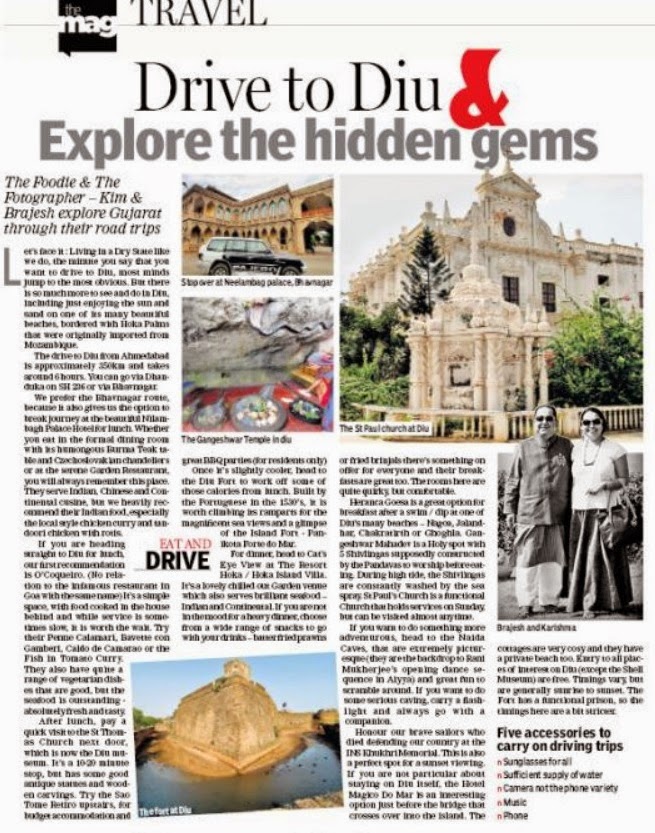
The Foodie & The Fotographer : Drive to Diu & Explore the Hidden Gems
12 October 2014
The Foodie & The Fotographer – Kim & Brajesh explore Gujarat through their road trips
Let’s face it : Living in a Dry State like we do, the minute you say that you want to drive to Diu, most minds jump to the most obvious. But there is so much more to see and do in Diu, including just enjoying the sun and sand on one of its many beautiful beaches, bordered with Hoka Palms that were originally imported from Mozambique.
The drive to Diu from Ahmedabad is approximately 350km and takes around 6 hours. You can go via Dhanduka on SH 236 or via Bhavnagar.
We prefer the Bhavnagar route, because it also gives us the option to break journey at the beautiful Nilambagh Palace Hotel for lunch. Whether you eat in the formal dining room with its humongous Burma Teak table and Czechoslovakian chandeliers or at the serene Garden Restaurant, you will always remember this place. They serve Indian, Chinese and Continental cusine, but we heavily recommend their Indian food, especially the local style chicken curry and tandoori chicken with rotis.
If you are heading straight to Diu for lunch, our first recommendation is O’Coqueiro. (No relation to the infamous restaurant in Goa with the same name) It’s a simple space, with food cooked in the house behind and while service is sometimes slow, it is worth the wait. Try their Penne Calamari, Bavette con Gamberi, Caldo de Camarao or the Fish in Tomato Curry. They also have quite a range of vegetarian dishes that are good, but the seafood is outstanding - absolutely fresh and tasty.
After lunch, pay a quick visit to the St Thomas Church next door, which is now the Diu museum. It’s a 10-20 minute stop, but has some good antique statues and wooden carvings. Try the Sao Tome Retiro upstairs, for budget accommodation and great BBQ parties (for residents only)
Once it’s slightly cooler, head to the Diu Fort to work off some of those calories from lunch. Built by the Portuguese in the 1530’s, it is worth climbing its ramparts for the magnificent sea views and a glimpse of the Island Fort - Panikota Forte do Mar.
For dinner, head to Cat’s Eye View at The Resort Hoka / Hoka Island Villa. It’s a lovely chilled out Garden venue which also serves brilliant seafood – Indian and Continental. If you are not in the mood for a heavy dinner, choose from a wide range of snacks to go with your drinks – batter fried prawns or fried brinjals there’s something on offer for everyone and their breakfasts are great too. The rooms here are quite quirky, but comfortable.
Heranca Goesa is a great option for breakfast after a swim / dip at one of Diu’s many beaches – Nagoa, Jalandhar, Chakratirth or Ghoghla. Gangeshwar Mahadev is a Holy spot with 5 Shivlingas supposedly constructed by the Pandavas to worship Lord Shiva before eating. During high tide, the Shivlingas are constantly washed by the sea spray. St Paul’s Church is a functional Church that holds services on Sunday, but can be visited almost anytime.
If you want to do something more adventurous, head to the Naida Caves, that are extremely picturesque (they are the backdrop to Rani Mukherjee’s opening dance sequence in Aiyya) and great fun to scramble around. If you want to do some serious caving, carry a flashlight and always go with a companion.
Honour our brave sailors who died defending our country at the INS Khukhri Memorial. This is also a perfect spot for a sunset viewing.
If you are not particular about staying on Diu itself, the Hotel Magico Do Mar is an interesting option just before the bridge that crosses over into the island. The cottages are very cosy and they have a private beach too.
Entry to all places of interest on Diu (except the Shell Museum) are free. Timings vary, but are generally sunrise to sunset. The Fort has a functional prison, so the timings here are a bit stricter.
5 Accessories to carry on driving trips
• Sunglasses & Caps for all
• Sufficient supply of water
• Camera - not the phone variety
• Music
• Phone
Read the Entire Article on the DNA Website
Sunday, 5 October 2014
The Foodie & The Fotographer : Take a Leisurely Drive to Velavadar National Park
5 October 2014
One of the easiest drives for good wildlife sighting in Gujarat is to the Velavadar Blackbuck National Park.
Velavadar, is about 140km away from Ahmedabad and a leisurely drive, takes around 2.5 hours with random stops for either photography or food.
You also have the option to visit Lothal and the Uthelia Palace enroute, for a peek into some history, if you so choose. The drive is very comfortable, roads are good and the only thing that you need to watch out for is - the actual turn, off the highway towards Lothal / Velavadar, that isn’t very clearly marked.
The Velavadar Blackbuck National Park is open from sunrise to sunset (except during monsoons) If you want to take just a day trip, depart from Ahmedabad at about 5:30-6 am, reach the park and go in for a drive. Have lunch at The Blackbuck Lodge, relax there until the sun loses a bit of its fieriness, go on another drive around the park and then head back to Ahmedabad.
The only reason, we suggest a day trip is because, the lodge has just 14 independent cottages and is constantly in high demand. However, to truly enjoy the beauty of this place and relax, it is advisable to spend at least one night at the resort.
The 35sq km Velavadar Blackbuck National Park park has grasslands, shrub lands, saline plains and mud flats, which support a variety of grass, 95 species of flowering plants, 14 species of mammals (blackbuck, nilgai, Indian grey wolf, striped hyena, Indian fox, golden jackal, jungle cat and smaller ones like hare, gerbil, field mice, mongoose and hedgehog), over 140 species of birds and many reptiles. The Alang and Paravalia Rivers, three artificial ponds, two check dams and nearby coastal marshes provide an ideal habitat for aquatic flora and fauna. From a conservation viewpoint, a unique feature of the park is that it is the only tropical grassland in India to be given the status of a national park. This used to be the private grasslands of the maharaja of Bhavnagar before it was converted into a national park.
Ardent birders head here for rare sightings of the lesser florican, endangered vultures, demoiselle cranes and a variety of raptors. The park also hosts the world’s largest harrier roost. We visited during the monsoons when the main park is closed (mid-June to mid-Oct), but we saw lots of blackbuck and birds and even a jungle cat on a general drive outside the national park. It is a single lane road and the road behind the Velavadar village has massive craters, so you need a vehicle with higher clearance (like one you could use inside the park) to make this drive.
The Blackbuck Lodge is the most peaceful resort that you can visit in Gujarat. The cottages are spaced out more like an African (think Kenya / South Africa / Tanzania safari resorts) resort than a Kutchi / Gujarati one. It is spread across acres and acres, with no boundary wall in sight, just rolling swathes of green and blue. The chirping of birds is brilliant background music to this visual relaxation.
They have a fantastic in house library (small, but with plenty of books on wildlife and lots of different magazines if you prefer) at the reception and the sit out here overlooks a beautiful lake, that makes it the perfect spot to cosy up with a book or just sit and contemplate the glorious silence.
You have to choose the all-inclusive plan as there is no other place nearby to visit for lunch or dinner, unless you plan to visit Bhavnagar for the day. But the food at every buffet that we tasted, was very good (you just have to adjust salt and chillies to your taste - they are served on the side). The non-veg is excellent and quality is very high. Its worth waiting to arrive here for your meal.
However, if you feel peckish along the way, the most popular stop is the recently opened Gallops that serves more-than-average highway food (for Gujarat), although most of the options are deep-fried.
Our personal choice was a much smaller and less swanky “Darshan Hotel” near Pipali which served us some of the best dal that we have eaten on Gujarat’s highways. Let the staff recommend what is best for the day and just trust them blindly, you can’t go wrong.
Whether you head here just for a day’s outing or for a long weekend, enjoy the park responsibly, do not harm or frighten the wildlife, avoid loud obnoxious behaviour and respect Mother Nature.
5 Point checklist before a long drive.
1. Fuel (The obvious full tank)
2. Air in tyres (including stepney)
3. Tool Box & Jack (you never know)
4. Papers - RC, PUC, Insurance, Licence (right side of the law)
5. Map Route - Paper or Virtual (while getting lost has its own charm)
The Gallops complex enroute has its own restaurant upstairs, an eatery downstairs, a couple of outlets outside selling chikkis, paan, channachor and frenchfries. CCD and Havmor are due to open shortly. Gallops kitchen isn’t very clean or inspiring, so we preferred driving a little further to Pipali and eating at Darshan Hotel.
The Blackbuck Lodge serves a lovely buffet, with salads, a fairly large vegetarian spread, a non-veg dish (chicken / mutton) and a dessert. We had some awesome mutton kurma, mutton roganjosh, kofta curries and gulab jamuns. Definitely don’t miss the amazing pista colored gur which is made in the village nearby.

Read the Entire article on The DNA Website
Monday, 8 June 2009
Obama in Cairo
The fact that a US President would be visiting a "Muslim Majority" Country before Israel, was in itself a huge departure in recent practice. There was speculation as to where he would speak from. Options ranged from Al Azhar Mosque (which I personally think would have been an excellent, yet impractical location) to Sharm el Sheikh. He settled on Cairo University.
The whole city of Cairo virtually came to a standstill on June 4th. Rumors abounded of 10,000+ snipers, 20,000 troops coming in on their own helicopters from the US and other such fantastic numbers were bandied about.
Passes to the event were carefully distributed by the American Embassy from what I gathered, to ensure an appropriate balance of profiles. 15 students from each major university were invited.
The Government declared a holiday for all its offices. A lot of Universities postponed exams to cope with this extra holiday. A number of private companies too decided to give employees the day off, fearing that they may be stuck in one of the road clearance drives. People who had parked their cars in certain areas along the route, were told to remove them the day before the President was due to arrive. (Now if we can only get similar celebrities to visit different parts of Cairo each day, we may be able to get those broken down heaps that masquerade as cars, that take up precious parking space to get towed away - How's that as a long term solution to Cairo's parking woes?)
But I digress. Coming back to the speech.
It was absolutely brilliant. There was no fault that an unvested interest could find in that speech except perhaps for him mis-pronouncing hijab and Al Azhar. But given the content and message, those are errors that can be easily overlooked.
The greatest strength of his speech was that he identified with his audience on a personal level. Compared to his predecessor whose speech writers made assume a superior and supercillious tone, Obama came across as "one of us". He drew attention to his Indonesian and Chicago life experiences amongst muslim communities.
He gave them praise where it was due, for their innovations in printing, algebra, architecture and then came to his main point. That he would fight negative stereotypes of Islam wherever they may appear. A statement that was greeted with loud applause, that almost died down with his following sentence "But the same principle should apply to Muslim stereotypes of America" This did not seem to be what the crowd wanted to hear. Until then, Obama had seemed to be a cheerleader for the Muslim world, but this statement showed that he wasn't going to unilaterally support the Muslim world. There was going to have to be some give and take.
Once the audience reconciled themselves to this idea, things improved again.
I will not get into the rest of the content of his speech, as it has been discussed ad nauseum on multiple fora.
It was a wonderful bit of speech writing to include references from the Torah, the Bible and the Quran. When he said "Jerusalem - is a place for all the children of Abraham to mingle peacefully", I had goosebumps and I know many Americans who have made Egypt their home, who were moved to tears by this sentence.
His body language was firm yet conveyed his openness to change. He came across as determined while engaging the public through eye contact and clear speech. Again, notable when compared with the last guy to hold his post.
He changed the terminology from the aggressive posturing of the previous government to one based on mutual understanding and dialogue. Instead of general nonsensical terms like "War on terror", he firmly stated that "America is not at War with Islam"
Another firm departure from previous policy was when he clearly stated "America does not presume to know what is best for everyone" If he can follow through on this and not have American Foreign policy and their idea of Democracy being stuffed down the throats of unwilling citizens of countries that aren't ready for the American idea of Democracy, it will go a long way in building bridges that had seemed burned and irrepairable a year ago.
The speech was transmitted live on Facebook and was texted as sms in English, Arabic, Farsi and Urdu. Thus upholding his campaign strategies of involving the younger generations by utilising media more familiar and accessible to them. It has also been uploaded onto Youtube.
The reaction to his speech by most locals that I know, has been "Let's wait and watch" "We want to see actions, not words" This guy is talking about change in policy, so maybe we can stop suspcecting the littlest sneeze. But to start trusting the Americans, we need to see concrete proof. We need to see steps being taken in the right direction. Words will not be enough.
It is undeniable that the US has a large role to play in World Politics. We can only hope and pray that instead of mindless wars and Nuclear arms races, we can at least have dialogue and hope for a future of peace.
In Obama's Words "All of us share this world for but a brief moment in time. The question is whether we spend that time focused on what pushes us apart, or whether we commit ourselves to an effort – a sustained effort – to find common ground, to focus on the future we seek for our children, and to respect the dignity of all human beings"
Also Published on desicritics.org
Friday, 28 November 2008
Disjointed Questions on the Bombay Blasts and its aftermath
My first long stay in Bombay was for my first job, with MBA degree in hand. The first weekend trip we took together as Management trainees was a local train ride from Andheri to South Bombay. We caught up with other batchmates in town for a movie at Metro Cinema and headed over to Cafe Mondegar for a drink and later carried onto Cafe Leopold because we had heard so much about these Bombay favourites. We then walked over to the Gateway of India and gazed at the iconic Taj Palace and towers. Gathering courage we felt we could project enough confidence to walk in and use their washrooms, which we managed.
Since this was the late 90's, B-School salaries weren't as astronomical as they were at the turn of the millennium and we obviously couldn't afford to eat in there, so we headed over to Bademiyan's for more affordable fare.
All these locations were under the media spotlight for the last 48 hours, for reasons one would never have dreamed about.
Personally, this attack was very hard hitting because of the sheer numbers of family and friends who live in the area, who were working late in the area, or were eating in the area after work. As is usual after every such attack in India, we started calling and smsing, then emailing and scrapping (when the phone lines were jammed and over loaded) and everyone we knew in the location to check on their status. This time it was a much, much longer list of people we were checking on.
Some were barricaded inside their houses and offices in the area while their lifts were shut down and they were advised not to leave the premises. Many spent that first night in the office while the rest of us helplessly spent the night hoping and praying for their safety and that the violence wouldn't spread to the surrounding buildings.
We stayed glued to the television and kept refreshing news sites on our computer screen and anxiously followed the sequence of events. Coherent thought was not easy and plenty of questions and inconsistencies kept popping up in my mind.
First of all: kudos to our NSG, army, hotel staff and police for their heroic efforts.
Why/How did this happen:
Intelligence failure is something the foreign media has been harping about in relation to these attacks, but as someone else mentioned: weren't 9/11 and the London Subway attacks, intelligence failures too.
Could we have done anything more to secure the locations?
How many locations will you secure? We have a country of a billion+ citizens, so I don't think it is about securing locations. Terrorists target any and every location. The only way every place can be secured is if citizens take responsibility of being aware of their surroundings and people around them.
We need to stop cribbing about and finding innovative ways to avoid security measures at malls, cinema halls etc. They are there for our security.
Our government should focus on stemming the problem at its roots: training camps, poverty, education, unemployment.
The terrorists were armed with AK47's while a lot of the police and railway police were equipped with nothing more than a lathi. Do they even stand a chance?
Why were 3 top cops traveling in the same vehicle?
Rescue efforts:
The staff at the hotels responded admirably and heroically. Some even lost their own lives while saving the guests. I am not sure if they receive training drills for terrorist situations, but they did their best.
Politicians have no business being anywhere in the area when such situations are ongoing. Having them around, means that security and armed forces are forced to divert their attention to the "security of the politician"
What business did Gopinath Munde have to be at the Nariman House today?
Same problem when they visit hospitals were the wounded are taken. Doctors and nurses are forced to stop tending to their patients and clear the area so the politician and their entourage of news crews and security personnel royally stroll through the area and promise tax payer funds (other peoples money) as remuneration.
Media:
While NDTV was the most restrained of the lot, our media still behaved as irresponsibly as always.
People whose family members were stuck inside, is it fair to thrust microphones at their faces and ask them how they are feeling?
Rescued people being brought out of the hotel after a horrifying ordeal, is it fair to thrust microphones at their faces and ask them how they are feeling?
While Right to Information is a wonderful act, some lines should be drawn when it comes to National Security. Broadcasting the immediate moves of the security forces, dissecting their rescue maneuvers, having ex army personnel describe helicopter rescue operations in detail - this only gives more intelligence to the terrorists holed up inside who could be in contact with anyone with a cable connection outside the location, even if cable connection at the hotels had been cut off.
Broadcasting false reports of the operation being over when it isn't because they see a thumbs-up being exchanged between two NSG personnel.
We need an appointed official spokesperson who is the only authority allowed to speak to the media when an operation is ongoing. This person needs to receive reports from all relevant sources and be advised on what news can be released and what cannot. Press should only be allowed at this location and not crawling around the affected area causing more security hazards or getting caught in the cross fire. This should give controlled information and hopefully control the rumour-mongering too.
If the press are controlled in one location, it will also prevent the crowds who were at the locations today not to show solidarity or out of concern but were there for the sole reason of getting their face on camera. (This is a reality in India)
Role of Politicians:
They haven't done anything to prevent the situation, they should stay away from the situation as mentioned above.
Where has the champion of Bombay, Mr Raj Thackeray disappeared to? Which safe location is he hiding in?
Our Home Minister was ineffectual as always. Surprisingly, our Prime Ministers speech didn't induce confidence either.
Politicians need to rise above their petty politics of deciding whether to hold a bundh on December 1st or not.
They should instead be visiting the homes of the brave security personnel who lost their lives and appreciating the efforts of their husbands, sons and fathers (not to be sexist, but no female personnel casualty has been reported yet in this case) who lost their lives in the service of the country. This is one of the few useful things that they can do at this point of time.
I also pray that they do not use this attack to further communalize our country for their own vote bank politics.
Future Action:
It may seem insensitive to say this at this point, but as a country we should take advantage of the terrorists targeting Americans, British and Israeli citizens.
The US previously tried to restrain India when they spoke about retaliation after the parliament attacks.
This is the right opportunity to use this joint sentiment against these terrorists to take a stand and launch a forceful offensive against terrorist camps targeting India.
Use the Israeli intelligence and their expertise to stem the flow of terrorists into India and destroy their their training camps.
We need a single security network that is pan-country, not disjointed co-ordination between multiple agencies.
We need to make our country safe again. Where people do not flinch at a loud sound, where people do not have to think twice before leaving their houses to catch a train, shop for groceries or watch a movie. We need to feel safe. It is our right as citizens.
Published on desicritics.org
Wednesday, 14 May 2008
Korba Street Festival - Heliopolis
Baghdad street was closed off to traffic and stalls were put up along the sidewalks. There were stalls from the Asean countries selling native food and some handicrafts.
The Indian stall just had posters urging visitors to visit India. Nothing else. :(
There were tables along the sides for families to relax and grab a bite and the main road was left free for kids to express their creativity on the road with chalk and paints.
Marriott's Bakery, Swiss Inn, Sultana Ice Cream had tables on the road and were serving food there. The Swiss Inn even had a buffet set up on the road. But the more exciting stuff to eat were the street stalls which were selling things like cotton candy,the hummus drink and beans.
I attended in the morning half and left by 1:30pm, before the crowds really started to pour in. This meant I missed out on the musical performances (by Wust el Balad among others) and the puppet show, but what I managed to catch was great anyway.
My friends tell me, there was a short parade later in the noon with flower covered floats and giant coke bottles. More of advertising than Spring flowers was a comment I heard.
What I got to see, kind of reminded me a bit of the Kala Ghoda festival in Bombay, but just a little bit. The concept is similar, but there is so much further that the Korba festival can go. Its a good start though, just to have an open air event in a residential area of Cairo.
I would definitely catch it again next year.
Also published on desicritics.org
Saturday, 9 February 2008
2008 : Africa Cup of Nations
But with Egypt's recent win against Ghana in the semi finals of the 2008 Africa Cup and the celebrations that erupted all over the city 2 nights ago. I could remain ignorant no longer and had to brush up before the finals tomorrow. Because Football is all that this country is talking about right now.
Football is to Egypt what Cricket is to India. An insider tip in Cairo is that the best time to travel around the city is before the midday prayers on Friday, during Iftaar time in Ramadan and during a televised football match (when Egypt is playing another country or Al Ahli is playing Zamalek) This is when traffic on Cairo's otherwise congested roads is almost non-existent. The city looks like a ghost town.
Al Ahli and Zamalek are local clubs. More often than not it is the Al Ahli club that wins, but that doesn't distract the Zamalek loyalists. Matches between these 2 clubs are so fierce, that they are almost always officiated by foreign referees.
Coming to the Africa cup, its been held almost every alternate year since 1957 (making it older than the corresponding European championship). This year is the 26th edition. Winning this tournament is a big deal because the winner gets to represent the Confederation of African Football at the 2009 FIFA Confederations Cup which is a prelude to the 2010 FIFA World Cup
Egypt has been a semi finalist 12 times thus far, but reached the finals just 50% of the time. So when Egypt won the semi finals against Ivory Coast (their co-finalist in 2006 Africa Cup of Nations) on the night of the 7th, the city turned 4-5 times noisier than usual. To those who have been in Cairo and thought it wasn't possible to get any noisier, I humbly invite you to be here during the finals and witness it for yourself.
Egypt is the nation that has won this cup the most number of times (5 of the 6 times that it has been in the finals) The other semi finals this year were between Ghana (host nation) and Cameroon - both 4 time winners of this cup.
The finals tomorrow will be between Egypt and Cameroon and the whole city is gearing up towards it. Flags are being sold on every street corner and major road (you might as well buy something patriotic when you are stuck in 3 hour traffic jams) Absenteeism will be at its highest tomorrow. If Egypt wins tomorrow, I don't even want to hazard a guess as to how long the celebrations will continue.
So if you are around during the finals, get home before the scoring starts and stay in no matter what the outcome because there will tons of people on the road post the match either celebrating or taking out their frustrations. Because whatever you may have heard: "It's not just a game!"
Published on desicritics.org
Tuesday, 5 February 2008
Kim is a Bonafide Cairene
Peter writes a weekly column for the Daily News Egypt called "A Khwaga's Tale"
This week the extremely interesting topic he undertakes is a checklist to help you recognise if you are a Cairene.
& Kim's whazzupegypt blog has been mentioned in the article as having a "Hip Name"
although there's an extra "t" in the name, which is sad Kim because that could have been huge potential for more eyeballs.
The article in its entirety can be read here http://www.dailystaregypt.com/article.aspx?ArticleID=11654
Thanks Peter, glad you like the blog & its name.
A KHAWAGA' STALE: You know you’re a Cairene when…
By Peter A. Carrigan
First Published: February 3, 2008
You know you are a Cairene when you leave the airport and sign your name as Donald Duck in that book administered by a lonesome policeman, who records your vehicle registration and destination.
I mean really, what is that register of vehicles leaving Cairo Airport all about? There must be hundreds of those dusty journals back at police HQ dating back to Agatha Christie. I wonder if she was the first to write down Donald Duck or Mickey Mouse.
So, are you a Cairene? Following is the Khawaga’s Tale’s check list to whether or not you can consider yourself truly immersed in Cairene culture.
You know you are a Cairene when you don’t care for haggling with taxis and just take the airport limousine service. Your bawwab pays for your ride when you arrive home and your luggage is brimming with pork products.
You know you are a Cairene when your phone rings in the cinema. You have a friend in Maadi who you’ve been meaning to call and you’re unsure whether Palestine is a State or a state of mind.
You have a delivery menu from your neighbourhood fuul and ta’amiyya spot. You have sushi home delivered for dinner parties and your morning coffee is also delivered on weekends, when you answer the door in your pyjamas.
You know you are a Cairene when you have eight random phone numbers of black & white taxis saved in your phone. You don’t know who Ahmed, Mustafa or Jane is, but you also have their phone numbers. And you have left a phone in a taxi, restaurant or on a felucca.
You are always busy when invited to Maadi for lunch or a genteel afternoon tea. You have attended more leaving parties than you have friends and you’ve been to Aswan, Luxor, Siwa and Dahab, but prefer Moon Beach.
You know you are a Cairene when you say you support Al-Ahly after realizing the Club is based in Zamalek, but feel you should be supporting Zamalek because that is where you live.
You always nod with authority when asked if you have read Max Rodenbeck, Robert Fisk or Noel Barber. You have two or three Arabic language books on your bookshelf, but spend most of your time weighing up whether or not to have both Showtime and Orbit.
You make an effort to go to historic Cairo and Khan Al-Khalili when you have visitors, but send your visitors off to the Pyramids by themselves.
You know you’re a Cairene when you have kissed a diplomat, fallen in love, fallen pregnant because there is something in the water here and fallen out at After 8.
You have a wallet full of unused bar tickets from the Canadian Club, BCA, Rugby Club and the British Embassy’s Phoenix club.
Reading Al-Ahram Weekly makes your head hurt, though you have heard it is more entertaining in French.
You know you are a Cairene because you wear shades inside, you think it is rude to be on time and you’ve finally realized that IBM is not a computer brand. You’ve stopped flicking the wing mirror in after parking as you’ve also realized that you never use it and you need constant noise to get to sleep.
You pine for the African Cup of Nations. You can’t remember that sailor’s name from Alexandria’s Spitfire bar and you have finally realized that you could never leave your cat and couldn’t afford quarantine anyway.
You write a blog with a hip name like; whatzzupegypt.blogspot, for expatriates.
You have started a cottage industry and gotten lost in the Mogamma.
You know you are a Cairene when you are wearing your blue jeans inside your knee high boots. You have one blow heater which you carry from room to room during January and you are wondering whether or not to join the exodus to Dubai.
Though, you realize you have been in Cairo too long because you remember your home country through rose tinted glasses; where politicians were honest, the streets clean and the service brilliant.
You have a thousand and one taxi stories. Your weekend starts on Wednesday night and you’ll never get used to going to work on Sundays. Your apartment has the ugliest chandelier in Cairo and your maid must have drunk that second bottle of gin!
And of course, you know you are a Cairene, because you never miss reading Khawaga’s Tale every Monday in Daily News Egypt.
Wednesday, 10 October 2007
The Ashera - The Latest in Indulgence
After Uma's post on Vodka with a dash of Diamonds I was left wondering what the next flagrantly expensive "in" thing would be.
I seem to have found an answer of sorts. But this time, its Alive. Its the latest - Lifestyle Pets. Although its not as expensive as the vodka and it lasts longer!
These aren't your run of the mill pet cats.
Its the ASHERA (please note the name is trade-marked) The worlds rarest and most exotic domestic cat. (so they say)
The Ashera is priced at $22,000, plus any applicable sales taxes and is due at time of order. Generally, the delivery date from receipt of payment is 9-12 months. However, for those customers who simply can’t wait to own an Ashera, a few selected kittens are available earlier for an additional cost of $6,000. All Ashera kittens are provided with a Certificate of Authenticity that will include an image of each kitten's DNA “fingerprint”.
Wait, it gets better :
All Ashera kittens are hand delivered to their new owners and hand carried on the transporting aircraft by a Lifestyle Pets representative. Total cost of delivery within the United States is approximately $1,500; outside of the USA they will quote you by location.
Included with the purchase of your Ashera kitten are the following:
* Complete and updated vaccinations through delivery
* Mandatory spaying or neutering
* Microchip Identifier implant
* One year of premium veterinary health insurance through Pets Best (USA customers only)
* Airline certified electronic climate controlled cat transporter
* Veterinary Health Certificate (required for travel)
* One set of nail caps already applied (these are vinyl nail caps applied to your kitten's claws that effectively cover the claws so no damage occurs to furniture, etc.)
Starter Pack (includes premium kitten food, additional nail caps, cat toys and other kitten sundries)
* One year guarantee (see purchase agreement for terms and conditions)
* 10 Year consultation access to Dr. Roland Tripp, internationally recognized animal behaviorist.
What's so special about these cats you may ask : They have been (bred and genetically) developed by blending exotic bloodlines of the African Serval and the Asian Leopard cat with the domestic cat. The cat weighs upto 14 kilos they are specially bred to have Leopard spots on their body and stripes on their limbs.
As an additional service, they have even introduced a limited payment plan to facilitate the purchase of an ASHERA kitten.
My concerns :
What happens to the kittens that don't come out with their stripes and spots in the advertised places? People aren't going to pay 22,000$ for those!
Whatever they may claim, these cats are bred from wild felines. They grow upto the size of 14 kilos/30 pounds. How safe can it be to have them around, especially with children? Some may argue that they grow to the same size and weight of large breed dogs, but these cats have a much closer link to their leopard forefathers.
They are currently developing a new breed of a very small dog. Wonder how much that would cost!
You can sign up for their newsletter on the site. I have, I definitely wanna know, what's next! Simple curiosity, I'm re-discovering that from my own cat (she's a naturally conceived mixed breed)
Published on desicritics.org
Monday, 24 September 2007
Twenty20 - Reactions From a Non-cricket Watching Indian in Egypt
Nothing personal against cricket, but I don't watch sports ! (This is my first post where I've chosen "Sports" as the Section) Except gymnastics, ice skating and synchronized swimming.
Equally crazily, I am married to the ultimate cricket fanatic, who watches matches, repeats, highlights and replays on the news (that's all of them - not an either/or choice). Who remembers statistics from games I never knew were played. For eg. He just said "We have never lost to Pakistan in a world cup" OK, not a great example, but it needed repeating :)
Another of his gems just before the last ball "For a moment, I thought about the last time a Haryana bowler named Sharma had the last over against Pakistan in a final. New Sharma, New ending"
Now these nuances are lost on me, but I'm sure there is a large group out there who can appreciate them. (Like the employees of various MNCs in India who officially closed office at 4 P.M. today.)
Being away from India for the first time on a long posting, he quickly ensured that we got all the right technology installed at home for regular access to cricket matches.
There's a small population of desis in Cairo (about 500) and an even smaller subset of cricket "fan"atics. The previous matches in the last year went by without much community feeling and viewing in this country. But this 20/20 brought a large portion of the Indian community together.
A couple of rational reasons for this would be the shortened timings in offices due to Ramadan (offices close by 3, the matches started at 2 - Egypt time) and the BCA showing the matches on a big screen where desis could get together and watch the matches in a group with alcohol available to drown sorrows or celebrate victories.
The group did avoid meeting at the club on the day of the India-England match because of the larger number of British supporters. But they regretted doing that by the end of the match.
Many of the Indians met up at the BCA for the days the Indians were playing. The non cricket watching wives would sit around and watch each others husbands bemusedly, wondering which of them would make a bigger scene at a missed catch or a wide ball.
We were of course happy that the matches were shortened, it meant less time sitting around. But it also meant shorter, almost non existent ad breaks (except 2 very irritating Horlicks & Sensodyne ads on Ten Sports) to try and communicate with your cricket lover.
Some of them would sit in the same crazy position that they were in when the last 6 was hit or wear the same clothes/shoes to every match. All kinds of crazy stuff that only fans can indulge in.
This was a good opportunity for us to get together and celebrate being Indian outside of India. Yuvraj's 6 sixes was obviously the biggest highlight till today's match. He does deserve the quarter-million and its good to see the BCCI giving something back to the players.($2 million for the team)
We watched today's match at home, but the phone calls kept coming and going throughout the match from across the world. Reactions & moods of the husband were oscillating from wild elation to extreme dejection at each ball. The little bits of the match that I did watch, I found it difficult to keep track since I couldn't recognise more than half the players (I had completely lost track of cricket from the time the slide started, plus this team had tons of newcomers to the international field)
But it was good to see a young team selected and though they had their health problems, they kept at it. Their confidence and perseverance are to be commended & rewarded. The cup and the 40 lakhs each are just a beginning.
Dhoni from all the conversations I caught, more than proved himself as being an able captain willing to take risks (who else would play a complete newcomer as opening batsman in a world cup final?)
He also showed more class in taking his shirt off and giving it to that little kid (I didn't catch who the kid was) rather than waving it around :)
From the strange tie breaker at the last India Pakistan match to the 6 sixes, to the final world cup win, it was an amazing journey even to the part time spectator.
The final run around the field with the Indian flags was a "rungte kadhe hone wala" scene that would warm the cockles of any Indians heart.
Way to go Indian team. This is a victory to savor for a long time and I hope it paves the way for more new comers into the playing Indian team.
By the way, we did this without a coach !
Photo Credit : Cricinfo.com
Published on desicritics.org
Monday, 16 April 2007
Flamenca - A Marriage of Spanish and Oriental Music
For the last few months, the only "local" music I've listened to or heard were of the Lebanese Music Video variety, which at its best is comparable to an "Item Number" and at its worst is worse than those Punjabi videos on ETC.
Fortunately this entire imagery associated with local music has been completely replaced by an infinitely superior quality and variety of music. Flamenca Cairo, a group of nine instrumentalists and a vocalist perfomed to a full house at the El Sawy Cultural Center last Friday.
The group was founded by Wael Khedr (who is also the Lead Guitar/Guitar Soloist) in 2003 with traditional Flamenco music and some Latin themes. It was slowly developed to have more oriental flavor with the addition of some oriental instruments. Now, Flamenca has several unique pieces of music where this marriage between flamenco and oriental music is clearly evident.
Amr Darwish plays a mean Electric Violin. The jugalbandis between him and Wael were outstanding.
Raaft Farahat plays an instrument called the Kawla which is an Arabic Flute.
Yamen Abdallah plays the Qanon which sounds like a Santoor - reminiscent of water trickling down a slow waterfall.
Omar El Toudy on Keyboards looked so much like those Senior Masterjis who play the keyboards in desi orchestras. Sameh Ismael and Sherif Kamal are the percussionists, who play a wide variety of instruments some familiar, some not so familiar and some completely tangential like the stool that Sherif was sitting on. Saief Eldawla on the Drums and Moustafa Geuida on Base Guitar completed the instrumental part of the ensemble.
Ahmed Samir intermittently provided vocals to the instrumental pieces. What a voice! Powerful and controlled. Although I could barely understand a word of what he was singing, I could feel the strong emotions and sentiments behind them.
The whole ensemble just blended together so beautifully. It has been a long time since any music has actually touched me. Flamenca's music was moving, it actually spoke to every member of the audience. So the repeated requests for an encore and the standing ovation that followed at the end was no suprise at all.
You can dowload and listen to some of their music on their site. http://www.flamencacairo.com/
Image Sources:These pictures have been taken from the Flamenca website http://www.flamencacairo.com/ and through Google Image Search http://images.google.com/
Published on desicritics.org
Wednesday, 14 February 2007
M T R Foods Sold for $100 Million
MTR Foods has taken a Scandinavian turn. It's not US spice king McCormick that will buy MTR Foods as speculated earlier, but the Norwegian foods-to-metals group Orkla.
Shock/dismay/sadness/happiness.... a series of feelings ran through me when I read these headlines in Finance Asia & the Times of India.
Shock since I did not have any idea that MTR was up for sale, being in this faraway land. Dismay & sadness that a Scandinavian Company has taken over at the helm of MTR. What do Scandinavians know about Kannadiga cuisine? Happiness that MTR as a brand was worth 450crore, three times its current turnover. But mostly I feel sad. What Orkla will do with the brand & the product compositions remains to be seen. But things can never be the same.
Why am I writing on business news which I normally just read & never write about ? Because I have a deep personal connection with MTR. To me, MTR is like the khansama from an ancestral kitchen who keeps giving me treats, tips and tricks to turn out better food in my own kitchen.
My love affair with MTR began when I moved to Bangalore in 1999 & was introduced to the Mavalli Tiffin Rooms in Lalbagh. The institution is over 80 years old and produces some of the best, most authentic South Indian Vegetarian cuisine ever. There is always a long line of people waiting to get in. Right from 6:30 in the morning when it opens. Fluffly idlis, crisp dosas, the rava idlis that they popularized. Words cannot do justice to their piping hot sambhars and other yummy food.
Three floors were not enough to house their customers, and they later branched out into a fast food principle based "Namma MTR" in Bangalore & Dubai to keep up with the demand.
MTR pickles found pride of place in my kitchen right next to the pickles that my mother and grandmother sent me. MTR spice powders and masala mixes were the number 1 choice if I did not have the time to make my own.
When I left for the US, half my luggage was MTR instant Bisibele Baath mix on request from several colleagues who were missing the "taste of home".
By the time I returned they had vastly increased their range and had also introduced the "Ready to Eat" line. Heat and eat, even simpler than the "Instant Mix" and much less oily than a lot of other brands prevalent in the Indian market.
When we moved to Cairo, a large part of our shipment consisted of MTR instant mixes - rava idli, dosa, upma, gulab jamun among others. From Soups to Ready mixes, to Papads to Chips to Ice Cream mixes to Pickles to Ready to eat and Frozen Foods - MTR prepares and sells them all to their hungry customer base.
Their forays into North Indian food and Malayali food can be forgiven since they seemed to manage a pretty admirable job with those items too.
The restaurant and the packaged food business were separate entities. As of now there isn't much clarity on whether the restaurants will also belong to Orkla.
I hope Orkla does not tamper with the product compositions because they have been perfected with a lot of care. I pray they do not destroy the brand completely like other MNC's have tried to do with Indian Acquisitions. And I wish they will start exporting to Egypt.
Published on desicritics.org
Thursday, 21 December 2006
Al Jazeera English: Is the News Good or Bad?
"The latest weapon in the Middle East is neither a missile nor a bomb. It is a Television Station."
I read this the other day in an editorial in Business Monthly, a journal brought out by the American Chamber of Commerce in Egypt.
The editor who was talking about Al Jazeera English going live goes on to say that by all reckoning, the slickly produced news broadcast is more powerful than the 170,000 coalition forces in Iraq with the potential to destroy administrations and topple governments.
Al Jazeera English was launched on 15th November 2006 as the first global English language news and current affairs channel headquartered in the Middle East. The channel is already available all over the world and free to air in most of them (perhaps in all of them) They claim to reach over 80 million cable and satellite households worldwide. It is also potentially available to the one billion users of the Internet worldwide as a live stream.
Headquartered in Doha, Al Jazeera aired its first exclusive on the 20th of November - news footage of Naypidaw in Myanmar - formerly Burma - and a high level interview with the Minister of Information, Brigadier General Kyaw Hsan.
Al Jazeera English was granted exclusive access to Naypidaw - a first for a foreign broadcaster. The interview ranged from Aung San Suu Kyi's detention, the roadmap to democracy, the move to Naypidaw, insurgencies around the country, and the effect of sanctions and the lack of aid to Myanmar's people.
Al Jazeera English's SOP states,
Broadcasting from within the Middle East, looking outwards, Al Jazeera English will set the news agenda and act as a bridge between cultures. With unique access as the channel of reference for Middle East events, and broadcast centres strategically placed around the world in Doha, Kuala Lumpur, London and Washington DC, Al Jazeera English will balance the information flow from South to North, providing accurate, impartial and objective news for a global audience from a grass roots level, giving voice to different perspectives from under-reported regions around the world.Al Jazeera English is building on the ground-breaking heritage of its sister Arab-language channel - Al Jazeera, which was responsible for changing the face of news within the Middle East, now extending that fresh perspective from regional to global.
Viewers of "Western" News Channels will find the formats abd imagery quite similar. They even have the familiar faces of David Frost (ex BBC) and Riz Khan (ex CNN Correspondent).
Reactions to Al Jazeera English here in Egypt have been mostly positive, considering that a lot of the population here has friends, relatives or acquaintances among the nameless and faceless people who are simply collateral damage to the American War on Terror. These people who are dying on "the other side" are simply statistics and numbers to the "Western" media. Forever to remain unnamed.
Hence Al Jazeera's tag line of "Watch the Other Side of World Events, Hear the Other Side of the Story" has found its mark. Their other affirmations like "We want to change the News Agenda - It's a Fundamental Goal," "Do the Right Thing for the Right Reason," all have found their mark at least among the English speaking population of MENA.
They don't seem to be heavily slanted in their perspective as of now. Someone mentioned that it's somewhere between the spectrum of FOX News and Hezbollah's Al Manar Channel and will slowly find its gradient on this scale of extremes.
The editor of Business Monthly summed it up brilliantly when he said,
Western Governments will need to carefully consider their political strategy - the World has a New Perspective and it comes from the people on the receiving end of their Foreign Policy.
Published on desicritics.org
Saturday, 8 July 2006
Ramadoss Running Amok ?
In a shocking Development, Dr. P Venugopal, leading Cardiologist and Director of the prestigious AIIMS, Delhi was unilaterally sacked on July 5th. This seems like a predestined conclusion to the long running feud between the "Honorable" Union Minister for Health & Family Welfare, Dr. Anbumani (sometimes spelt Ambumani) Ramadoss and Dr. Venugopal.
The Delhi High Court, stayed the Dismissal on Friday. So, the striking doctors of AIIMS got back to work after 3 days and patients are being taken care of again.
To get back to the issue, The background to this story is a 2 year old battle between the two. They've been at loggerheads ever since Ramadoss, a doctor himself, was appointed minister and he took over the AIIMS guest house for a lengthy period till he was allotted an official bungalow. The institute's grapevine is laden with stories about frequent clashes between the minister and the hospital administration over the lavish renovations at the guest house (which the AIIMS budget had to fund), the meals that went beyond the regular menu and the constant stream of visitors who had nothing to do with medicine.
Then, there was that ugly incident when Ramadoss decided to pay a midnight visit to the casualty ward. He didn't like what he found, summoned Venugopal and upbraided him and other senior doctors publicly. They've been at daggers drawn since. The friction exploded in a lightning strike by Class IV employees of the hospital, for which the faculty grapevine blamed some associates of the minister. Quick health check needed : Credit : DNA
Dr. Venugopal was ostensibly dismissed because of his soft stance on the Reservation issue. Those of you who followed Phase II of the Reservation protests (2006) in India, would remember that, the Medicos against Reservation was spearheaded by Medical Students at AIIMS on the AIIMS campus which was also the site for a Hunger Strike.
Ramadoss fired another salvo at the end of June. when an order pertaining to pay of striking doctors, issued by Dr. Venugopal, was described as 'null and void' by an official junior to him.
This entire "Reservation + Strike" issue gave Dr Ramadoss (as Health Minister, he also holds the position of president of AIIMS) the ideal excuse to sack Dr. P Venugopal.
After a 3 hour long meeting, the 17-member body of AIIMS passed the resolution for Venugopal's ouster despite three members expressing a voice dissent, said senior BJP leader V K Malhotra. He also said that Ramadoss suddenly brought in a supplementary resolution seeking removal of Dr Venugopal. In his generosity, Ramadoss offered that Dr. Venugopal be given 3 months salary but his services would be terminated immediately.
If this was just one vendetta of Dr. Ramadoss against Dr. Venugopal perhaps it could be forgotten in time as all other foibles of Indian politicians are. But Dr. Ramadoss seems to be using his office to massage his own ego.
If you look back at June of last year, Ramadoss proposed a ban on smoking in films and TV serials Now although there is ample proof against tobacco being bad for you, logic says that you should prevent the production and sale of tobacco, if you really are concerned about the health of a billion plus population. This was exactly the argument of Information and Broadcasting Minister Priyaranjan Dasmunsi. But Ramadoss was not willing to listen to reason. . .
It is a well known fact that his father, PMK leader S Ramadoss has had spells of bitter duels with filmstar Rajnikanth including a murder charge. Anyone who has watched a Rajnikanth movie or visited Tamil Nadu would know of his trademark style of throwing a cigarette in the air & catching it between his lips. This proposed ban seemed like a direct salvo against Rajnikant.
Fortunately, Information and Broadcasting Minister Priya Ranjan Dasmunshi said that while all measures need to be taken to discourage smoking, "content of a character (in any artistic venture) cannot be dictated or interfered with".
Looking at these cases, it seems that Ramadoss is hell bent on using his time in power to settle old scores and the new ones that he creates for himself.
If you want to write to the Minister himself, the Ministry for Health & Family Welfare site lists the following contact details :
Dr. Anbumani Ramadoss
Ministry of Health & Family Welfare Nirman Bhavan,
Maulana Azad Road
New Delhi - 110011
E-mail: hfm@alpha.nic.in
91-11-23061647
91-11-23061751
91-11-23061661
Published on desicritics.org
Saturday, 27 May 2006
Review/Photo Essay: Eternal Gandhi - A Multimedia Exhibition
At a time when Gandhiji's ideas seem to have become relegated to tomes of history textbooks, the Eternal Gandhi multimedia exhibition helps to bring his ideas back into focus in a medium that makes it easy for today's kids to relate to and understand.
The exhibits explore Gandhiji's philosophies, the books that moulded him, his ashram stays and other thoughts through computer generated designs and interactive installations. It is an attempt to explore and convey how Mohandas Karamchand Gandhi became the "Mahatma".
Conceptualised and directed by Ranjit Makkuni and his team at Sacred World Research Laboratory, the exhibition first displayed in Delhi and then moved to Bombay a couple of months ago. For awhile it was exhibited at the Cowasji Jehangir Hall.
But since the last month it has been displayed at the CSMVS. You still can catch it until the end of this month.
The Birla Trust has helped bear part of the costs of the exhibition.
What you can expect to see:
- Raghupati Xylophone: The notes are pre-arranged to play Gandhiji's favourite bhajan. You don't need to be a musician to play it.
- Laser India Harp: Allows the visitor to trigger music by touching the laser beams.
- Pillar of Castelessness: Embodies "United we stand and Divided we fall" by lighting up when all around the pillar hold hands and turning dark when they let go.
- Stambha: 11 rotating discs. Each triggers a visual clip of Gandhiji's principles of Satyagraha.
- A wooden replica of Sabarmati Ashram:
Each Pillar when touched starts an audio visual presentation of Ashram Life. - A Mural of Raja Harischandra's Story
- A fibre optic Jail Cell to mimic the one Gandhi was imprisoned in, which has his Jail journal beamed across the cell floor.
- The Charaka is everywhere,
- And an extremely life-like wax figure of Gandhiji which could have you thinking its a real person sitting there (the webbed toes gave it away),
as a motif, as a theme, as a background, as an exhibit....
...among other exhibits.
The exhibition is best summed up by a kid I overheard at the exhibition "Mommy, mommy! This is so much fun!!!"
To be relevant and speak to today's generation of kids, you need to involve them in the discovery process by stimulating not just their minds but by appealing to their visual and auditory senses too. Since the experience also combines a tactile dimension, it succeeds on all counts. The exhibition is equally appealing to adults too, it shows that we can make Indian museums a better leisure experience.
Posted on desicritics.org
Friday, 19 May 2006
Is India Turning Litigious Like The USA ?
The Telegraph Reports :
Foul cry over XLRI entry route
Jharkhand Education Tribunal (JET) today served a showcause notice on the XLRI School of Management, Jamshedpur, over alleged irregularities in the admission process.
The chairperson of the tribunal, Justice (retired) L.P.N. Shahdeo, today gave 15 days to the premier management institute to respond to the petition filed by a resident of Noida, Raj Gandhi, whose son had appeared for XAT this January.
In her complaint, Raj claimed that despite qualifying in the written exams, her son, Samrat, was not given admission to the institute.
Accusing the director of the institute and chairperson of the admissions committee of handling the admission process arbitrarily, she claimed that her son had secured 96.3 per cent marks in the written exam conducted in Jamshedpur and should have qualified even if he failed in the interview.
Samrat did not make it after he could not crack the interview round, a reason that has not satisfied his mother who blames his exit on the rampant irregularity in the admission process.
Expressing shock, XLRI sources said the student had approached the institute after not finding his name on the list of successful students and was conveyed the reason for his rejection. "Usually the ratio of the number of candidates called for interview and the number of seats is 5:1. So obviously there is a great chance that a good written score might not see the candidate in," sources said, adding that this was the first time such a charge was brought against the 57-year institute.
"His parents had come to me with a request for admission. But, we could not admit him as he did not qualify the interview. The All-India Council of Technical Education (AICTE) rules say the candidate must qualify both. We cannot ignore the guidelines," said XLRI director Father N. Casimir Raj.
He said the institute was yet to receive the showcause notice issued by the JET, which has said it will admit the case only after hearing out both sides.
Fortunately the JET has said it will admit the case only after hearing both sides.
Is India going the US way? Frivolous law suits are popping up all over the place.
Christian organisations secured a temporary stay on"The Da Vinci Code" a work of fiction because they feel people might believe it to be true.
Why are we so insecure in our own lives? What are we trying to prove? What are we trying to hide?
Lets look at the Mother of Samrat Gandhi: Mrs. Raj Gandhi.
She feels that just because her son has secured 96.3% in the XAT common entrance, he should automatically be given a seat at the institute. She says the selection process is arbitary.
In fact XLRI is one of the few management institutes in India which has done away with the GD process for selection, because they felt that the GD was arbitrary. A lot of potential students attend GD development classes & simply try to drown out the other participants voices. The ones who have good points to contribute but are too polite to shut down the others don't get a chance to speak.
Now lets look at the interview as a selection process. Specifically the XL interview process : There is a panel of 3 professors from the college. These professors have taught generations of students and are skilled in human behavior (at least one is normally from the OB stream) They are a 100 times better & more skilled at finding the right student than the triplet judges on a host of reality shows.
Just because someone has great marks it doesn't make them a great person or a great manager. (fyi: there are potentials who secure 99% too) In India the education system at the school level seems to focus only on marks and not the all round development of the child. Mrs Raj expects the same to hold at post graduation level too.
To be a great manager, you need some amount of intellect, some amount of empathy, some amount of maturity, some amount of logical reasoning and a few other things besides.
I think that : if Mr Samrat takes after the mother, quite a few of these qualities would be missing.
Unable to handle rejection, she has gone running to the courts, much like an American citizen who sues the city muncipality if he falls down on the street. That he might have been drunk is besides the point.
Mrs. Raj Gandhi needs to examine her own son & realistically consider his plus & minus points before rushing to the courts. Otherwise this may set off a slew of law suits against educational institutions & corporates too by candidates who interview with them (thinking themselves to be the cat's whiskers) and don't get selected.
Published on desicritics.org