Section 144 has just been clamped on Mangalore city.
Police resorted to lathi charge and throwing tear gas grenades at peaceful protesters where a number of nuns and women were injured and had to be taken to hospital.
What the hell is wrong with our country and its people? (I would not normally use such strong language in print, but it doesn't even begin to demonstrate how strongly I feel)
Today morning between 9am and 10am, Bajrang Dal activists attacked and destroyed 4 churches in Mangalore City.
Why? Because New Life members distributed pamphlets which said "Do not Worship Hindu Gods"
While I admit that this could be an incendiary statement, does this justify attacking people and churches who do not even agree with the methods used by the New Life preachers?
Does this justify attacking members of a church, who have not had anything to do with conversions or preaching and just listen?
Lets look at the issues here:
1. The Bajrang Dal resorts to violence because of something that is printed that they do not agree with.
2. When the Bajrang Dal says that conversions are illegal, (and all the other things they do with tis as their cause) aren't they infact enforcing that "you cannot worship any God other than a Hindu God"
3. The New Life Church is a relative newcomer, known to be more hardline than most other churches which distance themselves from them. Shouldn't the Bajrang Dal have at least distinguished that?
4. Even if they did not agree with what was printed by the New Life church in India, couldn't they try having a dialog with them first, before resorting to violence.
Looks like the hooligans behind these attacks are only interested in breaking bones and getting their adrenaline pumping rather than really trying to sort out any kinds of problems or misunderstandings.
The ruffians broke all the religious statues in the Sisters of Poor Clare's Adoration Monastery. They threw the Holy Eucharist on the ground and desecrated it.
Is this OK, just because it is being done against Catholics/Christians in India who have historically been as non-violent as the Jains and buddhists (other minorities) in India?
Concerned members of the churches gathered in the church grounds during and after evening mass in a peaceful way to seek assurance and guidance from the priests and other religious. Wasn't this a peaceful gahtering compared to mobs rampaging and torching buses because of some mud smeared on Meenatai's statue? or The countrywide riots following a desecration of an Ambedkar statue in Kanpur? The second incident was also of smeared mud. Both the desecrations happened on public roads. This does not make it right, but compare this to religious statues being broken on private property, the Holy Eucharist (which Christians believe is the body of Christ once it is blessed) thrown on the ground. Do not Christians have a right to congregate to discuss their fears following such incidents.
Remember the Christians were gathering in peace outside their place of worship (since the insides of the church were full) not going out and torching buses or hurting other innocent people.
To add fuel to the fire, the police arrived. No issues with their arriving where crowds had gathered, but they started lathi charging the gathered people and seriously injured nuns and women among the crowd and threw tear bombs inside the church where Sunday evening mass was being held. A religious ceremony, a peaceful ceremony, held everyday inside these churches.
Was this responsible on the part of the police to use force and violence against unarmed, peaceful members of the public?
People present at the scene said that the police themselves were pelting stones at the crowd and caning them, hurting both people and damaging property in the vicinity.
The news channels started to broadcast about this and then completely hushed up. I turned on my India feed of NDTV which promised for 15 minutes to show an update and news about Mangalore city and suddenly it stopped showing those banners without showing any news about what had happened. Looks like someone high in the political chain, got to them and yanked the news off the air.
Now take 2-3 other incidents into perspective.
On 29th August over 40,000 Christian Educational Institutions across India stayed closed to register a peaceful protest against the continuing violence against Christians in Orissa which has now spread to 13 out of 30 districts.
On the same day, the government of Karnataka announced its decision to take action against Christian schools in the state for closing without prior permission.
This same government has yet to take action against the Akhila Bharatiya Vidyarthi Parishat and RSS workers, who had launched violent protests when the JD (S) failed to hand over the state reins to the BJP last year.
Is it any surprise that both Karnataka and Orissa currently have the BJP in power?
The VHP held violent protests in Madhya Pradesh and other places asking why the Christians had killed Saraswati? (by shutting educational institutions for a day) What about all the occasions when the BJP/VHP/Bajrang Dal/Shiv Sena and other Hindu organisations force schools, colleges and business to shut shutter for their own bundhs which destroy all normalcy in the cities?
Why are these double standards in play? Why are Christians being given the short end of the stick? Religious Christian institutions have a large role to play in education, medicine, caring for the orphans, abandoned, old and dying in India. Christians have been one of the most tolerant minorities in India (imagine what would have happened by now if by chance the Bajrang Dal hooligans had desecrated a mosque this morning) who have contributed immensely to the growth of the country. Why this treatment? Do they deserve it?
Do they deserve a government that is apathetic to their religious sensibilities being trampled upon?
Christians have always believed in being peace loving, patient and tolerant. Will the Christian youth of today continue to be as tolerant when they see the atrocities being committed against their brethren in Orissa and the North East?
Why are these atrocities against Christians being downplayed in the media? (Try googling for the attack against Christians in India and see how many Indian media links pop up) Why aren't they being given coverage? Is it because the powers-that-be know that they aren't doing a thing to control, controllable situations and the miscreants in their party? Is it because the powers-that-be know that the Christians haven't ever retaliated with violence? How long will the Christians community be able to react with tolerance and peace? (2 values that a lot of Indians in the news seem to have completely forgotten about)
Final note of irony: Union minister of labour and employment Oscar Fernandes (a Christian) was in Mangalore today to inaugurate the opening of a (Hindu) temple.
And so we debate endlessly in the media about terrorism coming in from across the border while we burn our own own citizens in their homes and places of worship.
Also Published on desicritics.org
Sunday, 14 September 2008


Wednesday, 10 September 2008
Book Review : The Appeal
The latest bestseller from John Grisham after - The Innocent Man.
Given that the Innocent Man was a work of non-fiction, makes this book all the more frightening. Grisham himself was very excited about his first real legal thriller in years.
In this book (I wouldn't call it a novel) Grisham exposes the nexus between big business, politics and the law. While these have always been recurring themes in his books, this time in "The Appeal" it is the sole focus of the book.
The book starts with a chemical and environmental pollution case in small town Bowmore, Mississippi, now nicknamed Cancer County, where Krane Chemical is the accused and Jeanette Baker the plaintiff.
Jeanette has lost both her husband and son to cancer. This makes hers the strongest case to start with for her lawyers - Wes and Mary Payton. There are plenty of mass tort specialists and ambulance chasers waiting in the wings for the decision on this case, so they can all get themselves a piece of the pie (30% to the lawyers) while the Paytons themselves are over 400,000$ in debt by virtue of working and following up on this case (to the exclusion of all others).
The jury orders damages of 41 million dollars to be paid to Jeanette and here is where the plot actually takes off.
It is an intriguing ride that Grisham takes us on and is an excellent medium to learn how the Supreme Courts in the US work. Most states choose their Supreme Court justices by election, which leaves plenty of room for interested parties to skew the process. How that happens, is the meat of this book.
The ending may not please a lot of readers, but it is extremely realistic and I admire Grisham for leaving it there rather than neatly tying things up.
The book is extremely interesting and educating on the political and legal intrigue that takes place behind these elections. While this may be a work of fiction, it could very well become reality, any time in the near future and that is what is so scary about this book.
Also published on desicritics.org
Given that the Innocent Man was a work of non-fiction, makes this book all the more frightening. Grisham himself was very excited about his first real legal thriller in years.
In this book (I wouldn't call it a novel) Grisham exposes the nexus between big business, politics and the law. While these have always been recurring themes in his books, this time in "The Appeal" it is the sole focus of the book.
The book starts with a chemical and environmental pollution case in small town Bowmore, Mississippi, now nicknamed Cancer County, where Krane Chemical is the accused and Jeanette Baker the plaintiff.
Jeanette has lost both her husband and son to cancer. This makes hers the strongest case to start with for her lawyers - Wes and Mary Payton. There are plenty of mass tort specialists and ambulance chasers waiting in the wings for the decision on this case, so they can all get themselves a piece of the pie (30% to the lawyers) while the Paytons themselves are over 400,000$ in debt by virtue of working and following up on this case (to the exclusion of all others).
The jury orders damages of 41 million dollars to be paid to Jeanette and here is where the plot actually takes off.
It is an intriguing ride that Grisham takes us on and is an excellent medium to learn how the Supreme Courts in the US work. Most states choose their Supreme Court justices by election, which leaves plenty of room for interested parties to skew the process. How that happens, is the meat of this book.
The ending may not please a lot of readers, but it is extremely realistic and I admire Grisham for leaving it there rather than neatly tying things up.
The book is extremely interesting and educating on the political and legal intrigue that takes place behind these elections. While this may be a work of fiction, it could very well become reality, any time in the near future and that is what is so scary about this book.
Also published on desicritics.org
Sunday, 7 September 2008
Book Review : A Prisoner of Birth
Lord Jeffrey Archer is back with a bang! Doing what he does best. Writing fiction with revenge and justice as the major themes of his novel.
I have not been as lucky as IdeaSmith as to meet this Lord in person. But I'm sure it would be an amazing experience just to hear him speak on any topic on this earth. He has an astounding insight on what seems to be almost everything.
Lord Archer has proved yet again why he is one of the leading best selling authors of this generation.
The similarities to Dumas's Count of Monte Cristo are clearly evident in this tale and even the main protagonist keeps referring to the book. But Archer gives this tale a modern twist and spices it up with intimate knowledge of the details that he gathered during his 2 year tryst in Her Majesty's prisons.
The tempo of the novel keeps building up and its quite un-put-down-able (not sure if that is a word, but it describes this story aptly) To use a real word, this is a page turner. Definitely not bed time reading unless you plan to stay up all night until you are done.
This is a book that every mystery/crime fan should buy and read and re-read (its a book that may need to be read twice as new angles are discovered which have a different significance on past conversations and situations)
I'm now waiting for Paths of Glory which he is due to release in March of next year.
Also published on desicritics.org
I have not been as lucky as IdeaSmith as to meet this Lord in person. But I'm sure it would be an amazing experience just to hear him speak on any topic on this earth. He has an astounding insight on what seems to be almost everything.
Lord Archer has proved yet again why he is one of the leading best selling authors of this generation.
The similarities to Dumas's Count of Monte Cristo are clearly evident in this tale and even the main protagonist keeps referring to the book. But Archer gives this tale a modern twist and spices it up with intimate knowledge of the details that he gathered during his 2 year tryst in Her Majesty's prisons.
The tempo of the novel keeps building up and its quite un-put-down-able (not sure if that is a word, but it describes this story aptly) To use a real word, this is a page turner. Definitely not bed time reading unless you plan to stay up all night until you are done.
This is a book that every mystery/crime fan should buy and read and re-read (its a book that may need to be read twice as new angles are discovered which have a different significance on past conversations and situations)
I'm now waiting for Paths of Glory which he is due to release in March of next year.
Also published on desicritics.org
Saturday, 6 September 2008
Oasis - Grocery Shopping in Cairo


Grocery Shopping in Cairo
Karishma Pais (Kim)
If you are moving to Cairo as an Expat, then before you think of buying papyrus paintings or Egyptian Carpets, the first thing you need to know is where to buy daily groceries.
Here are some of the best locations to source your groceries. If you are fluent in Arabic then you may find that the local markets are more flavorful and interesting.
Personally, I love the local markets for fruits and vegetables, as the produce is much fresher than in stores and they can be washed clean. For meat and meat products, I prefer the bigger supermarkets, as the meat is cut and kept in hygienic conditions.
Metro Markets - a small supermarket - are dotted around the city. They have all the basics that you need for daily use. Some fresh fruits & vegetables. A small selection of raw meats, marinated meats, cold meats, cheeses & pickles. I have found them more expensive than the other local groceries or the bigger ones. They are convenient because they are normally a short distance away and most items are labeled in English, as are the prices.
In some neighborhoods, without a Metro Market, you may find Kheer Zaman supermarkets, run by the same people. They do not carry as many imported products as Metro does.
The El Hawary Supermarkets are similar to Metro, but with lower rates. The locals shop here. A word of warning: Most prices are written in Arabic, if they are written at all. The store personnel cannot speak much English & the stores are quite crowded. The aisles are small & have a lot of people jostling for space, for themselves and their trolleys. Once you know which brands you like & can speak a few words in Arabic then you can try shopping here.
For your major shopping, try Carrefour. It’s a Hyper Market where you can get everything you want -that’s available in Egypt- in quite a few varieties. You do get good discounts & they always have some offer on. Most of the service staff can speak basic English or can refer you to someone who does speak English. The aisles are wide, the air conditioning works, lots of choice, good rates. Drawback : It’s a long drive from most residential areas. There's one on the Cairo-Alex desert road at Dandy Mall & another at Maadi City Center (on the Ring Road) They are both located in pretty decent malls, so you can plan a day around the experience. The Dandy Mall Carrefour is cleaner and less chaotic than the one in Maadi.
Spinneys at City Stars mall in Nasr City, is similar to Carrefour. The Electronics and clothes sections here are much larger than the other Hypermarkets. It’s convenient to pick up groceries from here after spending a day at the City Stars Mall or watching a movie.
If you are more confident of yourself & know for sure which brands you want to purchase, then HyperOne in 6th of October City, is the best option among the hypermarkets. Their prices are much lower & they have a larger range. Most locals shop here. It’s completely worth the drive for monthly shopping. HyperOne is run by the same people who own the El Hawary chain of supermarkets.
Between Hyper1 & Carrefour, I would recommend Carrefour for cold meats (tastier) & unpacked spices in barrels (labeled in English and cleaner). For everything else, Hyper1 is a better bet.
Alfa Markets are spread out in some parts of the City. They carry a lot of products imported from the UK including English rose patterned ceramic cutlery. But, they are expensive. The Zamalek branch, is the best of the Alfa Markets that I have seen.
There are smaller stand alone stores like Miriams supermarket and Kimo supermarket in Maadi, that carry a lot of imported products and even fresh home baked cakes and cookies by Expat women.
The local markets are always good for fruits & vegetables. They are fresher than the produce sold in supermarkets. These are recommended, if you can speak Arabic and you can judge fresh produce by looking at it or smelling it.
You can buy lovely spices at the Khan El Khalili for much lower rate than at the supermarkets. But be ready to bargain. Most of these guys can speak enough English because of the sheer number of tourists that visit the market.
Your neighborhood grocer will have a lot of the stuff that you may suddenly run out of, but you may be overcharged. On comparison, over time, I know the grocer next to my house overcharges me, but the shop around the corner gives me a fair deal and delivers home even if it is just a loaf of bread.
If you are new to Cairo, then you may find that it’s easier to walk up to the closest Metro Market where prices are fixed & marked. At least there you know that you are paying the same as the other customers, even if t is a little more.
Most grocery stores will deliver home. The Hypermarkets deliver home for a fee or a certain minimum purchase. If you carry them home yourself, your bowab or his wife will carry your shopping bags to your apartment for a small tip (50p to 2LE depending on how much stuff they have to carry and if they use the stairs or an elevator)
Karishma Pais (Kim) is an expat trailing wife in Cairo. She has a Masters Degree in Human Resources and Behaviour. She consults on HR projects, delivers intercultural training at the CSA, counsels new and experienced expats, writes for several magazines – online and offline, she runs whazzupcairo@yahoogroups.com and whazzupcairo@googlegroups.com among other activities. Her Social Commentary and blog about life in Egypt can be read at http://whazzupegypt.blogspot.com
Oasis - Where should I live in Cairo?


Where Should I Live in Cairo?
Karishma Pais (Kim)
The question I get asked the most by newcomers to Egypt, often before they even arrive, is “Where should I live?”
Quick Orientation :
Cairo is the capital of Egypt & the business centre.
Alexandria is a lovely Mediterranean Seaside town 4 hours drive away from Cairo and has its own international airport too.
Port Said & Port Suez are along the Suez Canal. A lot of people who work in the shipping industry are posted in these towns.
Sharm el Sheikh & Hurghada are the party towns on the Red Sea Coast. But if you work with a hotel chain, you are likely to be posted here.
Luxor and Aswan are in Upper Egypt and are the ancient Pharonic towns.
These are the main cities that expats live in.
This article is about places to live in Cairo.
The best advice I can give you is: Stay as Close as Possible to your Area of Work or Study!
Traffic in Cairo means that it can take ages to reach from point A to point B. It's better to live as close as possible to your office or college/university so you can save a ton of time on traveling and use that time more productively.
If you are an Expat with kids then your child's school is another major consideration to keep in mind. Which school? How long will it take your child to travel from home to school? Is there a school bus facility? Is there a convenient pick-up location?
In a toss up between your own/spouses office location & child's school location, you need to take a call for yourself and your family that will best suit your needs.
If you are a student, then you may also like to stay in walking distance to a Metro station. The Metro service in Cairo is efficient & extremely beneficial to anyone who doesn't have their own means of transportation in this city or who doesn't want to drive here.
Areas to live in :
Maadi : The choice of a majority of expats. Close to many international schools. Maadi is a lot greener than a lot of other areas in Cairo. It boasts plenty of organizations catering specifically to or of interest to expats like the Community Service Association (CSA), Cairo Rugby Club, Studio 206, Ace Club - Association of Cairo Expatriates, Cairo Hash House Harriers, Cairo Petroleum Wives, Maadi Womens Guild, Serafis among others.
There are bungalows (stand alone houses) 2/3 floored buildings as well as a couple of high rises.
Rents are higher in this part of town. But it is worth it for the benefits of the greenery, community living and established conveniences for foreigners.
Zamalek : An Island on the Nile in the centre of the city. It is the location of choice for embassy employees (a lot of embassies are located in this area) and students. The old AUC hostels are located in this area. The constructions are older here but not necessarily in bad condition. The apartments are really huge and spacious with high ceilings and wooden floors.
Garden City: Similar to Zamalek. The rent rates would be slightly lower than Zamalek. It is just across the river towards Maadi and boasts wonderful views of the Nile from most apartments.
Mohandaseen: The business part of town. It started as a residential area for and is an extremely busy part of town. A lot of offices are based in this area. There are plenty of restaurants and cafes in this part of town.
Dokki: A residential area between Mohandaseen and downtown. Slightly secluded and not as chaotic as downtown for those who have to travel there for work or to study.
Most of the restaurants and clubs are clustered around these areas of town.
There are other areas of town that are comfortable to live in too. These include downtown Cairo, Heliopolis, Nasr City, 6th of October city and El Rehab City.
Excepting downtown (which is logically in the centre of the city and close to everything) the others are on the outskirts of the city and it takes some time to reach the city centre from these locations. But they are better planned with more greenery, parking spaces and less traffic.
Nasr City is also home to City Stars the largest mall in Cairo. A shopaholics delight with tons of stores, restaurants, food courts and cinema halls.
There are plenty of malls planned for 6th of October City, Rehab City, Kattameya, Ain Shams and other newer parts of town. A lot of the universities have been moving out of the congested heart of Cairo into these new and developing areas. In some places like Kattameya it may be difficult to find furnished apartments right now. So the choice would be between apartment fixtures and time taken to travel
This is just a quick primer on some residential areas in Cairo. Rates will depend on size of apartment/house and location. For example within Garden city itself similar apartments may rent for different rates based on quality of construction, amount the owner has spent on doing up the place etc.
So find yourself a good "semsar" - real estate agent - and happy hunting.
Karishma Pais (Kim) is an expat trailing wife in Cairo. She has a Masters Degree in Human Resources and Behavior. She consults on HR projects, delivers intercultural training at the CSA, counsels new and experienced expats, writes for several magazines – online and offline, she runs whazzupcairo@yahoogroups.com and whazzupcairo@googlegroups.com among other activities. Her Social Commentary and blog about life in Egypt can be read at http://whazzupegypt.blogspot.com


Tuesday, 26 August 2008
Won a Cookery Contest
Rushina from A perfect bite... had a Hot and Spicy Pakora contest! sometime ago.
I submitted a favorite recipe of mine for Prawn Pakodas
I was one of the 3 winners of the contest. So I guess Rushina and her judges (family) liked it :)
Here's the link to the announcement and links to the recipes of other winners and participants.
http://a-perfect-bite.blogspot.com/2008/08/results-of-hot-and-spicy-pakora-contest.html
I submitted a favorite recipe of mine for Prawn Pakodas
I was one of the 3 winners of the contest. So I guess Rushina and her judges (family) liked it :)
Here's the link to the announcement and links to the recipes of other winners and participants.
http://a-perfect-bite.blogspot.com/2008/08/results-of-hot-and-spicy-pakora-contest.html
Tuesday, 12 August 2008
My Article on the Marico India Website!
My Article on "Life in Egypt" was picked up and posted on the Egypt section of Marico India's corporate website at
http://marico.com/marico_worldwide/egypt/kims_article.pdf
http://marico.com/marico_worldwide/egypt/kims_article.pdf
Sunday, 27 July 2008
Book Review : Diplomatic Baggage: The Adventures of a Trailing Spouse
As a Trailing Spouse to Egypt, this was a book recommended at an Inter-cultural training session that I attended.
I am glad I waited 2 years to read this book (I might have been terrified of the move) although I'm kicking myself for spending money on it, even though I got it at a discounted price on Amazon.
I got carried away by William Dalrymple's (an author I greatly admire) review of it: "Brigid Keenan, is a new comic genius.... very, very funny"
Later in the book, I figured out that he spent time at their house in Damascus, while researching his book From the Holy Mountain.
Why did I hate the book so much?
Except for the last chapter, the author was constantly whining and groaning about the hardships that life had tossed at her. This after choosing to marry her husband of her own free will, knowing the kind of job he did and loved would take him to obtuse corners of the world. It was a fully informed decision that she took. Even spending some days with him, in what she calls a "chicken shed" in Kathmandu before deciding to marry him.
She constantly whines about everything from the help, to the kids, to her husband, to location.... in short, she whines about Everything.
The life of a Diplomatic Trailing Spouse is much easier than that of other Trailing Spouses. Accommodation, household help, office help, everything is put in place before the diplomatic family even arrives at their new location. Brigid's grouse is that some of the other European embassies provide more services to the spouses than her husbands European Commission ambassadors office does.
She promotes herself as a glamorous, successful young London fashion journalist, but later in the book accepts and acknowledges that her children were the worst dressed in their school.
I do not know Brigid personally, but what I read in her this autobiography of hers, made me think of her as a spoiled, over indulged wife who can never find anything positive and good in life.
Granted she had a few scares like the maggots that got under the skin and had to mature and grow and eat their way out, but those kind of experiences were less than you could count on one hand. For the most part, she was preoccupied with how to find whit gloves for a 6 fingered servant in India and wondering why there was no association to put beggars to sleep the way Animal friends does it for animals! At the same time brushing aside her daughters experiences with pedophiles and exposers as casual asides.
Brigid has written about Kashmir's art and crafts and co authored a book on Damascus; which may be worth looking at, but Diplomatic Baggage is not a book you want to buy or gift a friend who is going to be a Trailing Spouse, not unless you want them to cancel all plans and send their spouse to live abroad on their own.
Published on desicritics.org
Camel Market at Birqash, Egypt
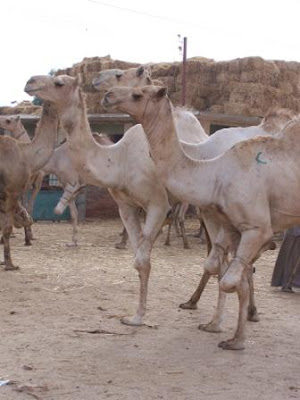
Egypt's Largest Camel Market - Birqash Camel Market is 35km away from Cairo. The best day to visit is supposed to be Friday, when the market is most lively in the earlier parts of the morning 7am-9am. The market is open till 1pm but most of the trading happens before 11am.
This market used to earlier take place in Imbaba, but as the city expanded, the camel market was moved to the suburb of Birqash which is at the edge of the Western Desert.
Hundreds of Camels are sold here everyday. But this is definitely not a market for the Animal lover. The animals aren't in pitiable condition, but they could be treated much, much better than they currently are.
Camels from Sudan are brought into Egypt on the 40 day road via Abu Simbel to the market in Daraw. The unsold camels are then loaded into trucks and brought to Birqash after a 24 hour drive. Camels also arrive from the rest of Egypt and sometimes from Somalia. These camels are traded for other livestock or cash and are mostly bought for farm work or consumption.
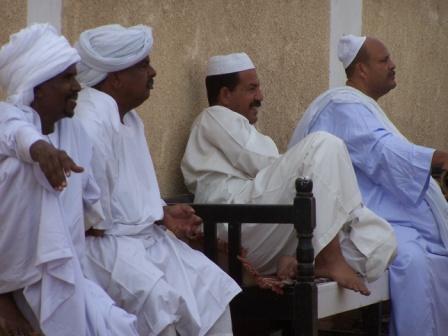
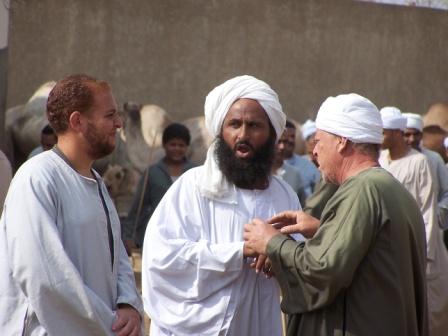
Photo opportunities abound, if you can get the angles right since the camels are almost monochromatic in color. The traders have wonderfully charactered faces and I would have loved to be able to take close up portraits and talk to them and listen to their stories. Unfortunately as a woman, taking close up pictures of men is not the sanest thing to do. And my Arabic is too limited to have had a proper conversation with them.
As an obvious foreigner, you will be charged entry to the market. (it has a gated entry) 20LE per person. Then they may try to charge you an additional 10LE per camera. Once you enter, you will not face any obvious resentment. The traders are pretty welcoming of foreigners and try to make a buck or so by posing for pictures with them. There were at least 10 other foreigners the day we visited.The only thing to be aware of is to not behave like an Animal Rights Activist and they will pretty much maintain their distance for the most part.
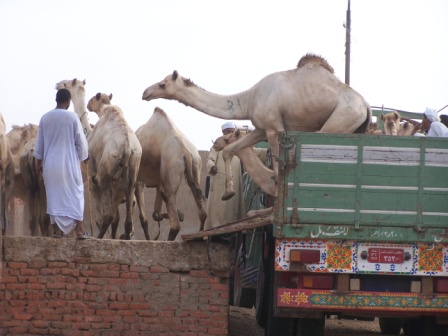
The market extends inside for a distance with sections cordoned off by walls for certain traders. Small single level constructions provide basic housing for traders. The roofs of which are covered with bales of hay. There are basic ramps built for loading and unloading camels from the trucks.
Obviously not all the camels are sold and some of them may not be worth carrying back. Some don't even survive the truck ride to Birqash. Their corpses are carelessly strewn about the desert as you approach the market. There are a few pictures of that at the bottom. Please don't scroll to the end, if you are squeamish.
Thanks to all my online friends who helped me find directions to the market. The best ones were provided by Karim who said Take Cairo/Alex highway to Abu Rawash road. You take a right onto Abu Rawash road which is right before the Carrefour/Dandy mall parking lot. You take this until you reach the end of the road where it intersects with the Mansouriyya Canal road. Take a left onto the Mansouriyya Canal road. Keep going for a ways and start looking for signs, either the suk il gamaal sign or Nimos Farm sign, on the left-hand side of the road. Take left onto small canal road and go until the end where you hit a midaan/circle. There will be a sign pointing towards the suk and it's only a little ways down the road from there. Leaving from downtown on an early Friday morning, this way can get you there in 45 minutes if you use the Mahwar.
Thomas also gave a good alternate route if you are closer to the pyramids
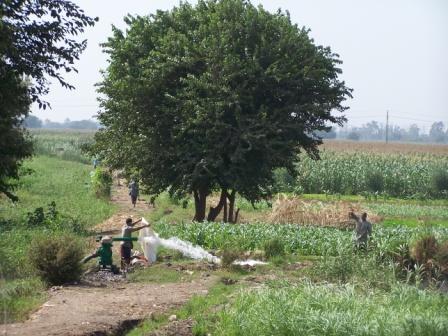 and is very reminiscent of the UP and Punjab fields. The River Nile in the background is of course, unique to Egypt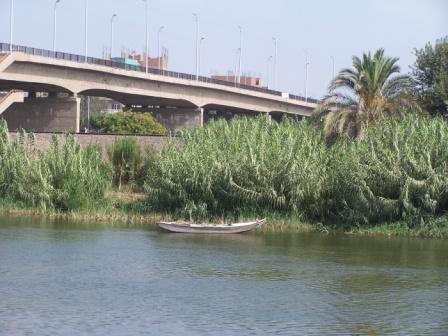
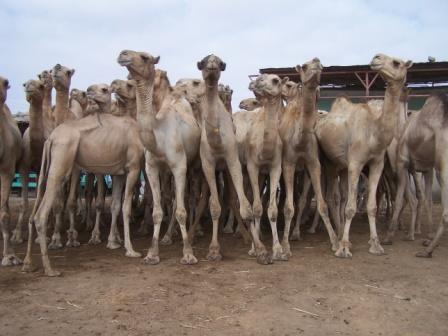

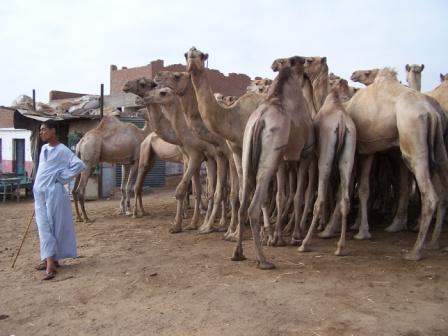
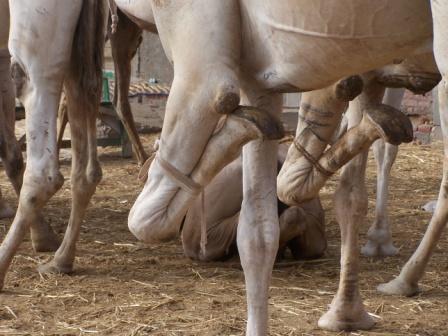
Some of the camels have one of their legs tied to prevent them from running away.
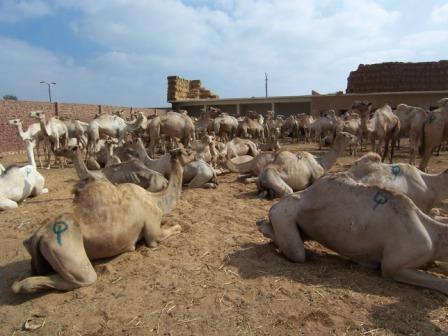
Walled Compound
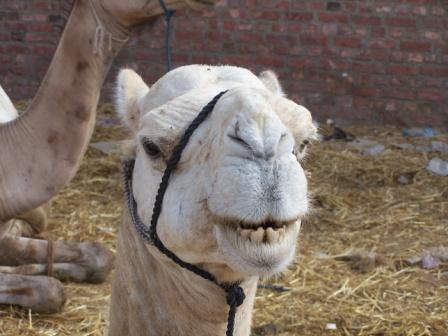
Quality check of camels like horses is done by inspecting the teeth. This one showed us his teeth voluntarily.
Unloading of Camels
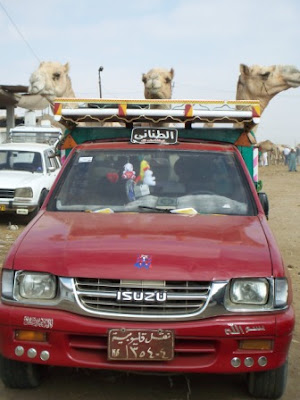
Sold camels being taken away in a pick-up
Some of the character filled faces
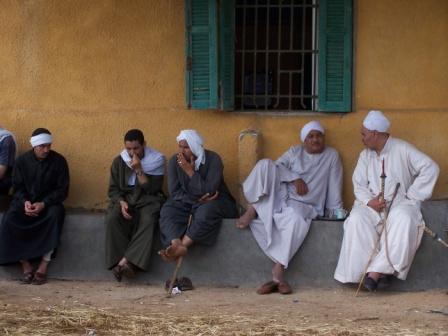
Warning: The pictures below are quite gory.
Please do not scroll down if you are easily upset.
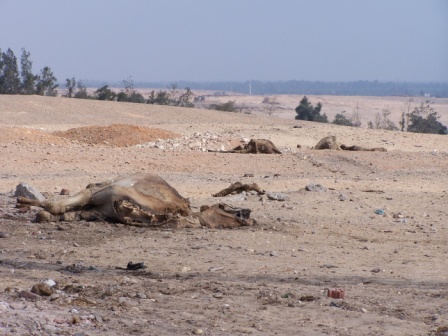
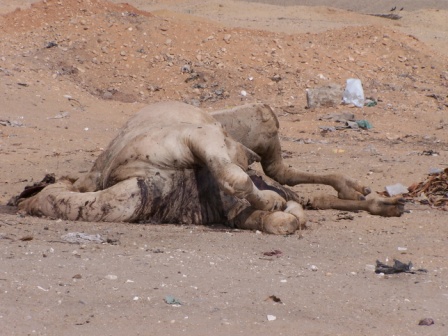
Death is inevitable, but I wish, they could at least dispose the bodies in a less conspicuous and more humane fashion, rather than just leaving it out to the elements.
Some of the facts, come from the Lonely Planet guide for Egypt
Many of the pictures were taken by my husband
Published on desicritics.org
This market used to earlier take place in Imbaba, but as the city expanded, the camel market was moved to the suburb of Birqash which is at the edge of the Western Desert.
Hundreds of Camels are sold here everyday. But this is definitely not a market for the Animal lover. The animals aren't in pitiable condition, but they could be treated much, much better than they currently are.
Camels from Sudan are brought into Egypt on the 40 day road via Abu Simbel to the market in Daraw. The unsold camels are then loaded into trucks and brought to Birqash after a 24 hour drive. Camels also arrive from the rest of Egypt and sometimes from Somalia. These camels are traded for other livestock or cash and are mostly bought for farm work or consumption.
Photo opportunities abound, if you can get the angles right since the camels are almost monochromatic in color. The traders have wonderfully charactered faces and I would have loved to be able to take close up portraits and talk to them and listen to their stories. Unfortunately as a woman, taking close up pictures of men is not the sanest thing to do. And my Arabic is too limited to have had a proper conversation with them.
As an obvious foreigner, you will be charged entry to the market. (it has a gated entry) 20LE per person. Then they may try to charge you an additional 10LE per camera. Once you enter, you will not face any obvious resentment. The traders are pretty welcoming of foreigners and try to make a buck or so by posing for pictures with them. There were at least 10 other foreigners the day we visited.The only thing to be aware of is to not behave like an Animal Rights Activist and they will pretty much maintain their distance for the most part.
The market extends inside for a distance with sections cordoned off by walls for certain traders. Small single level constructions provide basic housing for traders. The roofs of which are covered with bales of hay. There are basic ramps built for loading and unloading camels from the trucks.
Obviously not all the camels are sold and some of them may not be worth carrying back. Some don't even survive the truck ride to Birqash. Their corpses are carelessly strewn about the desert as you approach the market. There are a few pictures of that at the bottom. Please don't scroll to the end, if you are squeamish.
Thanks to all my online friends who helped me find directions to the market. The best ones were provided by Karim who said Take Cairo/Alex highway to Abu Rawash road. You take a right onto Abu Rawash road which is right before the Carrefour/Dandy mall parking lot. You take this until you reach the end of the road where it intersects with the Mansouriyya Canal road. Take a left onto the Mansouriyya Canal road. Keep going for a ways and start looking for signs, either the suk il gamaal sign or Nimos Farm sign, on the left-hand side of the road. Take left onto small canal road and go until the end where you hit a midaan/circle. There will be a sign pointing towards the suk and it's only a little ways down the road from there. Leaving from downtown on an early Friday morning, this way can get you there in 45 minutes if you use the Mahwar.
Thomas also gave a good alternate route if you are closer to the pyramids
The road that leads there is accessed from right next to the Giza Pyramids, but I can't easily describe how to find it. (Kim's note : at the main circle take the road that goes to Kerdasa/ Mansoureyya) If you ask a couple people in the area, one should point you in the right direction.
Once on this road, you end up following it straight about 20-25 min and then you make a left at the camel market sign (in Arabic) and drive about 1-2 kilometers to the market.
Good luck.
Alex gave me a good tip. He said that the road would make the car smell and it would be better to take a Yellow Cab. While this is extremely true if you take the Imbaba canal route (the road was piled high with garbage on both sides for the most part and quite nauseating even with our windows up and the air conditioning on), the Pyramids, Kerdasa and Abu Rawash routes are more scenic and pleasant and can be done in a regular car.
The Drive through the Nile Delta makes you forget that you are surrounded by the largest desert in the world.Alex gave me a good tip. He said that the road would make the car smell and it would be better to take a Yellow Cab. While this is extremely true if you take the Imbaba canal route (the road was piled high with garbage on both sides for the most part and quite nauseating even with our windows up and the air conditioning on), the Pyramids, Kerdasa and Abu Rawash routes are more scenic and pleasant and can be done in a regular car.
 and is very reminiscent of the UP and Punjab fields. The River Nile in the background is of course, unique to Egypt

Some of the camels have one of their legs tied to prevent them from running away.
Walled Compound
Quality check of camels like horses is done by inspecting the teeth. This one showed us his teeth voluntarily.
Unloading of Camels
Sold camels being taken away in a pick-up
Some of the character filled faces
Warning: The pictures below are quite gory.
Please do not scroll down if you are easily upset.
Death is inevitable, but I wish, they could at least dispose the bodies in a less conspicuous and more humane fashion, rather than just leaving it out to the elements.
Some of the facts, come from the Lonely Planet guide for Egypt
Many of the pictures were taken by my husband
Published on desicritics.org
Subscribe to:
Posts (Atom)
LinkWithin
